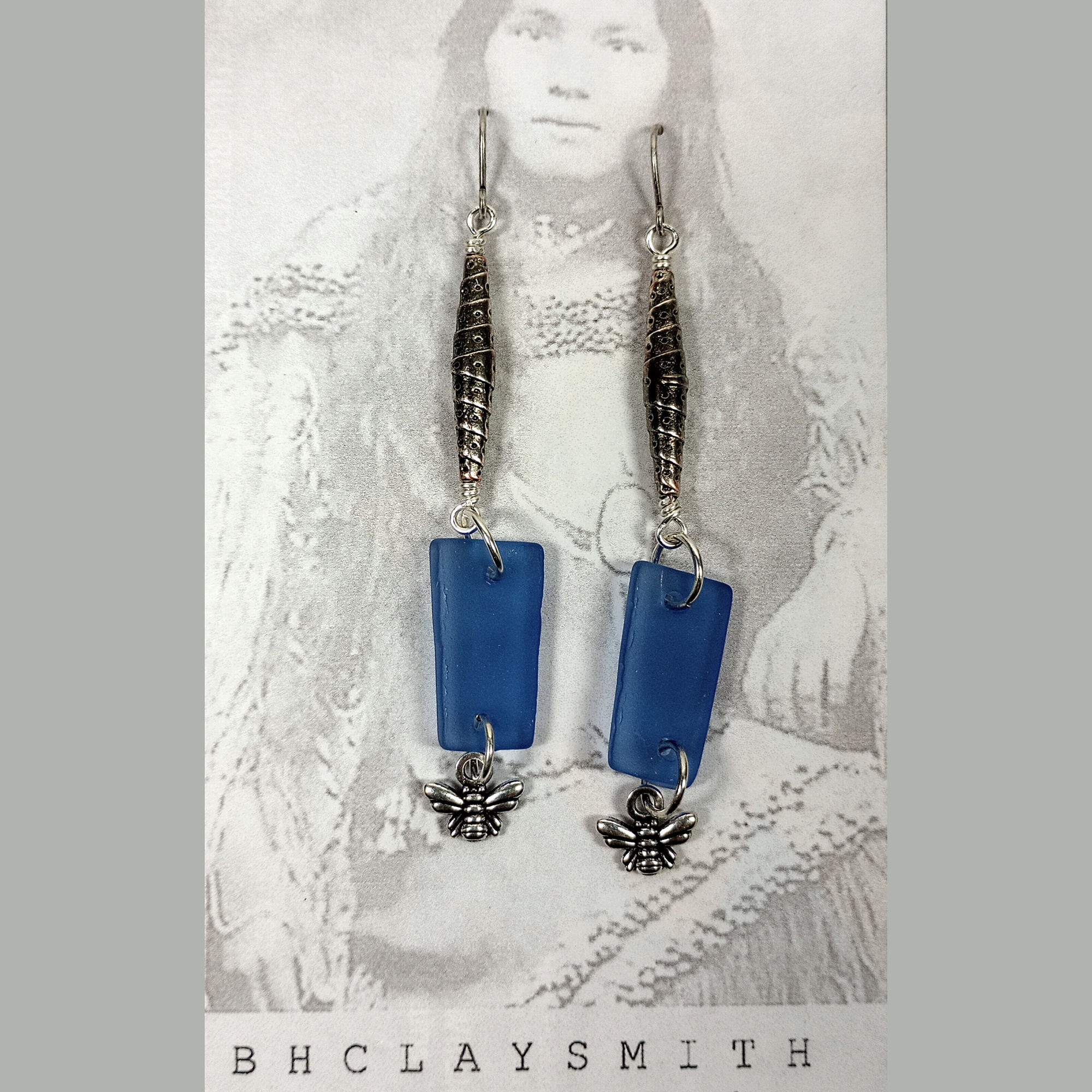
BH Claysmith

When our ancestors descended from the trees millions of years ago and took an upright position, their hands were free for new uses such as making artifacts, instruments and drawing on cave walls. Our individual biological nature or ‘who we are’ is who we were; we carry the genes of everyone who came before us and with that, a need to create. As both an educator & artist, I am intent on protecting, nurturing and celebrating the creative spirit and insuring it will never become obsolete.

Tuesday, February 10, 2009

CLAY BEADS for SALE

CLAY BEADS for SALE
Posted by BHClaysmith at 4:02 PM
Labels: Beads, ceramics, Clay, earthenware, Hand made, stoneware, terra sigillata

Friday, January 9, 2009

Clay Cabochons and Wire Wrapping

Clay Cabochons and Wire Wrapping
Posted by BHClaysmith at 1:55 PM
Labels: adornments, Beads, beads of clay, cabochon, ceramics, clay to wear, copper, wire wrap

CLAY and COILING

CLAY and COILING
Posted by BHClaysmith at 12:26 PM
Labels: Beads, bowls, ceramics, Clay, earthenware, featherweight, Hand forms, Hand made, jewelry, necklaces, pendants, Pinchpots, Pottery, stoneware, terra sigillata, transfer printing

B E A D S - A Brief History of All Sorts of Beads

Posted by BHClaysmith at 12:21 PM
Labels: adornments, Beads, beads of clay, BRACELETS, cabochon, ceramics, Clay, clay to wear, earrings, earthenware, Hand forms, Hand made, jewelry, necklaces, pendants, pins, wire wrap

Saturday, November 15, 2008

CLAY TO WEAR EXHIBITION

Posted by BHClaysmith at 11:10 PM
Labels: Beads, beads of clay, BRACELETS, cabochon, ceramics, Clay, clay to wear, copper, earrings, earthenware, hand building, Hand made, jewelry, necklaces

Sunday, July 6, 2008

MAKING CLAY BEADS from Two Part Molds

Posted by BHClaysmith at 10:20 PM

MAKING a TASSEL BEAD from CLAY

Posted by BHClaysmith at 10:17 PM
Older Posts
Subscribe to: Posts (Atom)

MY CREATIVE PHILOSOPHY

All of my clay work is hand-built and one-of-a-kind. Some pots do bear a family resemblance but each remains unique unto itself. Using my own pinch-strip or slab method of construction, I build up the side walls to capture the space within. As the piece begins to breathe on its own and a personality emerges, I yield to the nature of the clay. No longer am I in control of where I go or what lead I follow, or even what occurs when I get there. THE CLAY SPEAKS TO ME. It tells me what it wants to be when it grows up and I listen. We transform each other - my clay work becomes my vision; I become my clay work. My entire being, not just my hands, is an integral part of the process. What emerges just HAPPENS – from the visual appeal to the featherweight feel of each piece. My creative philosophy is a contradictory mix of Nike's "Just do it!" and the Beatle's "Let it be," both practiced in the spirit of author Tom Robbins who writes, "It's never too late to have a happy childhood." CLAY - I LOVE WHERE IT TAKES ME !

Creativity in Society Today

When our ancestors descended from the trees millions of years ago and took an upright position, their hands were free for new uses. They perfected the overhand throw and engaged in making tools. This made them dangerous predators.

By devoting the hand to the more complex tasks of making artifacts, instruments and drawing on cave walls, brain capacity increased. Drawings became stories. Music, song and dance were born. The use of hands, language and visualization all evolved interdependently and the individual started to form.
Human behavior is profoundly influenced by these learned skills of the past which go a long way to define who we are today. Our individual biological nature or ‘who we are’ is who we were. Genetically we carry the genes of everyone who came before us and with that, the ability to discover our own unique predisposition for the need to create.

But we live in a consumer oriented culture driven by technology. Why bother to encourage labor intensive, demanding and often un-marketable visual arts, crafts, wearables, music, performance arts and literature?

Because those of us who use our hands, language and cognition to create do so as an antidote to this very technology which alienates us from society. Making clay vessels, creating art to wear, penning poems, blending colors on canvas, composing concertos, weaving, dancing, singing, photographing and filming - all of these, validate who we are! Our self-expression gives us meaning. It is a personally rewarding passion - a legitimate way of resisting a culture of bigger, faster and right away.

Creativity communicates. The maker's mark, though not always evident, forms a shadow of the work itself. It tells us a skillful, caring person has been there. The attitude of a time card puncher is never present when someone is driven to do something well. The work becomes endowed with a powerful emotional charge and a sense of sincerity which is instantly felt by others. More often than I like to admit, contemporary society ridicules the importance of feelings and does not particularly value the passion exuded by the creative spirit or their work.
But those who create have chosen a lifestyle which goes against the grain. Learning to embrace all that it entails, then be available for others embarking on the same journey is my charge. As both an educator and artist, I am intent on protecting, nurturing and celebrating the creative spirit and insuring it will never become obsolete.

A NARRATIVE ON MY CAREER IN CLAY

Before I found clay, I ate, slept and breathed interior and architectural design, and spent all of my time engrossed in the needs of others. I had no life without my client list. Then in 1994 while on vacation, I attended a workshop given by Jeanne Haskell at The Vermont Clay Studio in Montpelier, Vermont. At the time, I didn't know the difference between wet clay and the mud in my driveway, but once my hands started poking and stretching and feeling the hunk of clay I was allotted, I knew I had to learn more. Upon returning home, I immediately signed up for classes at Perkins Center for the Arts in Moorestown, New Jersey and The Clay Studio in Philadelphia, Pennsylvania. I took workshops offered by clay artists whose work I came to admire through area galleries and national publications. I was being consumed by all things CLAY. The more I experienced, the more I realized there is to experience, and the more I needed to ‘do clay.’ Although I didn't start out on the wheel learning to make strictly functional ware such as plates and bowls, I did begin hand building very utilitarian pieces. I love gladiolas, and I never had a vase tall enough to hold them, so I slab built a whole series of ‘GLAD’ vases. Three of the first ten leaked, and I quickly learned about properly attaching a bottom and testing for water-tightness at the bisque stage. At classes and workshops I was introduced to texturing and stretching clay, building forms which have three-legs, lids, handles or spouts and using engobes such as terra sigillata as alternatives to glazes. I raku-fired with Steve Branfman in Vermont, sawdust-fired with Jimmy Clark in Chester Springs and was quickly becoming a clay junkie! Sometimes my drug of choice was stoneware; sometimes earthenware with an occasional snort of cream cheese porcelain. Other times I reached nirvana by simply burnishing or texturing the various clay bodies I had on hand. Intent on exploring everything I had been exposed to in more detail, I mentally filed away ninety percent of the information for future exploration, then set about starting at the beginning and mastering the three basic hand building techniques of pinching. coiling and slab construction. My own ‘pinch-strip’ method of hand building evolved from combining elements of these basic techniques. After hand rolling a slab of clay to one eighth inch thick, I cut strips from the slab and continue compress rolling the strips to a thickness of less than one sixteenth inch. These paper-thin strips form the basis of my ‘pinch-strip’ clay constructions. Attaching the initial strip to a clay base, I then pinch each new strip to the one underneath, building up side-walls and capturing the space within. No matter what the piece becomes - a bowl, a pitcher, a gesture pot - it is the space within that makes it useful - benefit comes from what is there; usefulness from what is not there. Eventually the vessel starts to breath on its own. It takes a stance. It gestures. It whispers what it wants to be when it grows up ... and I LISTEN. I follow its lead, never really knowing what is being constructed until we're done. Finishing a pot with the right glaze was always harder than making a good clay form. Glazes never were explained or discussed at length in any of the classes I took at area art centers; our work came out of the bisque firing and we were expected to thoughtlessly dip our pieces in buckets of runny liquid to create a finish. For years I fought this idea and turned to brushing or pouring glazes on my bisque ware. Then I had an epiphany - the clay slabs I roll out are the fabric I use to make my pieces. If I were a fashion designer, would I attempt to manufacture a line of clothing without first envisioning the colors, textures or patterns of the fabrics I would use for each creation? Of course not! So, why was I doing this as a clay artist? Why was I building forms out of clay ‘muslin’ when I could be using clay fabrics rich with textures, patterns and colors… I began fantasizing about clay surface finishes at the conceptual, greenware stage and the numerous ways to achieve them. Three years ago, I started an intense investigation into engobes, terra sigillatas, colored earthenware & stoneware clay bodies, stains and underglazes with and without the application of glazes. I constantly explore new ways of creating colorful patterns, textures and finishes on clay slabs and continue to fine tune the transfer-printing methods of German potter, Martin Mohwald which I learned at The Clay Studio in Philadelphia. AND I’m still obsessed with HOW MY PIECE WILL LOOK BEFORE I EVEN KNOW WHAT MY PIECE WILL BE! Simply put, I’m hell bent on becoming familiar with ALL my options. I draw upon my years of acquired knowledge constantly and still employ a thought provoking ‘what if’ every time I sit down to create my signature work. I also offer workshops and classes through area art centers to clay enthusiasts where I share my own and other artists’ techniques of hand building and my enlightening discoveries about how to create clay fabrics and understand the role glazes play on the pots we make. CLAY... I love where it takes me. Barbara Hanselman